Preventing Mold Growth: Professional Moisture and Ventilation Practices Every Construction Company Should Master
2025/09/11
Thank you for reading our blog today.
Cases of mold recurring after home renovations are unfortunately all too common. In particular, when moisture control and ventilation are neglected, even the best renovation work can end up wasted. As a construction company, it is essential to prevent such issues before they occur.
In this article, we explain the key precautions construction companies should take during projects, along with real success cases from the field. From moisture control and ventilation design to the selection of building materials and aftercare, this guide is packed with practical knowledge.
By applying these methods, you can strengthen construction quality and build trust with clients. You will also gain the expertise needed to prevent problems and deliver long-lasting, comfortable living spaces.

1. The Importance of Pre-Construction Surveys and Design Planning
In renovation projects, issues with mold and moisture can develop into serious problems over time. That is why it is critical for construction companies to identify moisture risks accurately during the pre-construction stage and establish proper design and work plans. Neglecting this initial step may result in mold growth after the project, leading to costly rework and potential client complaints. In this section, we explain the essential surveys and design considerations that should be carried out before construction begins.
1-1. Visualizing Moisture and Mold Risks with Infrared and Airtightness Testing
During pre-construction site surveys, it is not enough to rely on visual checks or intuition. Using tools such as infrared cameras and airtightness testers is highly effective for identifying temperature differences and areas of moisture buildup inside walls and under floors. Infrared cameras can clearly show indoor temperature distributions, making it easy to spot condensation-prone areas or weak insulation. Airtightness testing, on the other hand, measures the overall air leakage of a building (C-value), which is useful for planning proper ventilation. By pinpointing high-risk areas based on this data, construction companies can smoothly determine the best ventilation systems and insulation materials to implement.
1-2. The Importance of Specifying Moisture Control and Ventilation Plans in Design Documents and Contracts
Based on the site survey results, it is essential to clearly document moisture control measures and ventilation system details in the design documents and contracts. Doing so prevents misunderstandings between the client and the construction company about the scope of work. This is particularly important in areas prone to mold growth, such as bathrooms, closets, and attics, where proper exhaust and intake routes and moisture barriers must be explicitly stated. Clearly defining these elements helps clarify responsibility and reduces the risk of disputes later on. Additionally, explaining in advance how mold-related issues will be handled if they arise during the contract stage enhances trust and demonstrates accountability.
2. Key Points for Selecting Ventilation Systems and Installation Methods
The success of mold prevention largely depends on the ventilation environment at the site. In renovation projects especially, it is necessary to select and install effective ventilation systems while ensuring compatibility with the existing structure. To prevent moisture buildup and reduce condensation, it is essential to design airflow systematically and install functional ventilation equipment with precision.
2-1. Characteristics and Selection of Type 1, Type 3, and Local Exhaust Ventilation Systems
There are three main types of ventilation systems: Type 1, Type 2, and Type 3. In renovation projects, Type 3 systems are most commonly used due to cost and space limitations. A Type 3 system relies on mechanical exhaust while allowing natural air intake. This makes the system simple and easy to install, but in buildings with low airtightness, its effectiveness can be limited. On the other hand, a Type 1 system uses mechanical control for both supply and exhaust, ensuring a stable airflow. This makes it suitable for highly airtight and well-insulated homes. However, it requires more investment and greater installation effort, so the choice should be based on the building’s performance and installation location. In areas where moisture tends to accumulate, adding localized exhaust fans is also highly effective.
2-2. Ventilation Design for Moisture-Prone Wet Areas and Attics
Bathrooms, washrooms, toilets, and kitchens are wet areas where moisture is frequently generated, making them prone to mold growth. In these spaces, it is essential to install dedicated exhaust ventilation systems and balance them properly with air inlets. Furthermore, “invisible spaces” such as attics and crawl spaces are especially vulnerable to insufficient ventilation and require close attention. Proper placement of vents and exhaust ducts, as well as consideration of potential interference with insulation materials, should be incorporated into the design to achieve effective moisture control throughout the entire building. In renovation projects, where existing structures impose limitations, it is crucial to strike a balance between constructability and effectiveness when planning duct layouts and securing power sources.
3. Building Materials, Substrate Treatment, and Moisture Control
In renovation projects, proceeding with finishing work while leaving moisture unaddressed can cause mold to regrow inside the structure, severely damaging the living environment. For this reason, the selection and treatment of “substrates” and “building materials,” which are not visible once the work is completed, are extremely important. Simply cleaning the surface is not enough; fundamental moisture control is essential.
3-1. Choosing Humidity-Control Materials and Insulation Measures (e.g., Diatomaceous Earth)
Effective mold prevention requires proper moisture management, and the use of humidity-regulating building materials is the first step. Natural materials such as diatomaceous earth and lime plaster have the ability to absorb and release indoor humidity automatically, helping to prevent mold growth. In addition, installing high-performance insulation materials or secondary interior windows can reduce condensation and lower moisture within walls. This is especially important during winter, when large temperature differences between indoor and outdoor air increase the risk of condensation. In such cases, selecting the right insulation materials and ensuring precise installation are key to effective moisture control.
3-2. Addressing Deep-Rooted Mold: The Process of Disinfection → Drying → Substrate Replacement
When existing interior materials are contaminated with mold, surface cleaning alone is insufficient. Mold hyphae often penetrate deep into the substrate, making a multi-step process essential: disinfection → thorough drying → substrate replacement if necessary. For highly absorbent materials such as gypsum board or plywood, painting over or overlaying is ineffective. After applying antifungal treatment, sufficient drying time must be secured, followed by the use of moisture barriers and airtight tape to minimize the risk of recurrence. Furthermore, when selecting antifungal agents, it is important to choose low-volatility, long-lasting formulations that can maintain their effectiveness over time.
4. On-Site Practices to Watch Out for During Construction
On site, it is not enough to simply follow the drawings; flexible and accurate responses tailored to actual conditions are required. In particular, mold and moisture issues are difficult to detect once the finishing work is completed, so the decisions and actions taken during construction have a significant impact on overall quality. In this section, we outline key points to watch for on site to prevent mold from recurring.
4-1. Avoid Overlaying and Design to Prevent Structural Ventilation Blockages
The method of overlaying new materials on existing walls or floors can be effective for shortening construction time and reducing costs, but it carries the risk of trapping moisture and mold inside the structure. In areas where condensation or mold has occurred in the past, it is essential to thoroughly remove surface materials, inspect the condition of the substrate, and, if necessary, dismantle before proceeding with new work. In addition, “ventilation design” that considers airflow within walls and under floors is critical. For example, by paying close attention to the placement of insulation and ventilation openings, and ensuring that airflow is not obstructed, it is possible to create a structure that is less prone to moisture buildup.
4-2. The Importance of Multi-Trade Coordination and Site Management Systems
Thorough mold and moisture control requires close coordination among multiple specialists, including carpenters, electricians, plumbers, interior finishers, and ventilation contractors. For instance, while carpenters install vapor barriers, electricians and mechanical contractors handle the placement of exhaust fans and ductwork. If these tasks overlap or the sequence of work is disrupted, the effectiveness of the antifungal and moisture-control design can be compromised. Therefore, site supervisors and managers must oversee the entire process and quality, ensuring effective communication and timeline adjustments. Special attention should also be given to humidity management on site, particularly during the rainy season or when unexpected rainfall occurs during construction.
5. Establishing Aftercare and Warranty Systems
If mold reappears after a renovation, constantly dealing with the problem can lead to a loss of trust and damage to the company’s reputation. True customer service begins after the construction is completed. To provide mold-prevention renovations with confidence, it is essential to establish a clear aftercare system and warranty program.
5-1. Regular Inspections, Clear Warranty Terms, and Support Systems
After a renovation is completed, it is ideal to schedule regular inspections within a set period to check for moisture conditions in the treated areas and to confirm the operation of ventilation systems. In particular, conducting inspections during winter—when condensation inside walls is more likely—or around the rainy season makes it possible to detect early signs of mold. In addition, clearly stating the scope, duration, and exclusions of the warranty in contracts and work reports ensures smooth handling in case problems arise. This approach strengthens trust with clients and creates a positive cycle that leads to repeat business and referrals.
5-2. Contract Design to Avoid Liability and Legal Disputes
Mold and moisture are often difficult to see and can also be influenced by lifestyle habits or furniture placement, meaning they are not always the result of construction defects. Therefore, clear explanations in advance and careful contract design are extremely important. For example, explaining risks associated with conditions such as “failure to ventilate properly” or “placing a large number of houseplants indoors” helps prevent disputes. Furthermore, when mold or condensation is discovered during construction, creating a photo-based report and recording the remedial actions taken provides valuable evidence in case of future issues. These careful measures not only reassure clients but also contribute to building long-term trust.
6. The Effectiveness of the Specialized Mold Removal Technology: MIST Method®
Traditional mold countermeasures often relied on surface-level treatments such as wiping, scrubbing, or covering with paint, which were insufficient for fundamentally preventing recurrence. This is where the unique mold removal technology developed by Kabibusters, the MIST Method®, has gained attention. This method is a groundbreaking treatment that decomposes and removes mold that has penetrated deep into materials—without causing damage to the substrate—and provides long-lasting effectiveness to prevent regrowth. For construction companies, understanding this method and proposing it in the right situations can greatly enhance both reliability and differentiation in their services.
6-1. What Is the MIST Method®? Gentle on Materials, Tough on Mold
The MIST Method® is a customized approach that adjusts specialized mold-removal agents on-site according to the type of material and the kind of mold present. For example, wood, concrete, wallpaper, tatami mats, and stone all have different levels of permeability and pH, making a one-size-fits-all chemical ineffective. With the MIST Method®, the solution is tailored to the material’s hydrogen ion concentration, allowing mold to be removed without scrubbing or scraping, and without damaging the surface. This high level of reliability has led to its use even in the restoration of cultural properties and historic buildings. A key feature is its ability to decompose and kill mold at the microbial level.
In addition, the specialized agents have passed industrial wastewater safety tests, ensuring they are safe for both people and the environment. This makes them suitable for use in homes and facilities where small children and elderly residents live, giving construction companies a strong advantage when emphasizing safety to clients.
6-2. Comprehensive Treatment: From Removal to Prevention with the MIST Method®
Another strength of the MIST Method® is its ability to provide comprehensive treatment, covering not only removal but also long-term prevention. Mold spores float in the air and can reattach to surfaces, leading to recurrence if no measures are taken after cleaning.
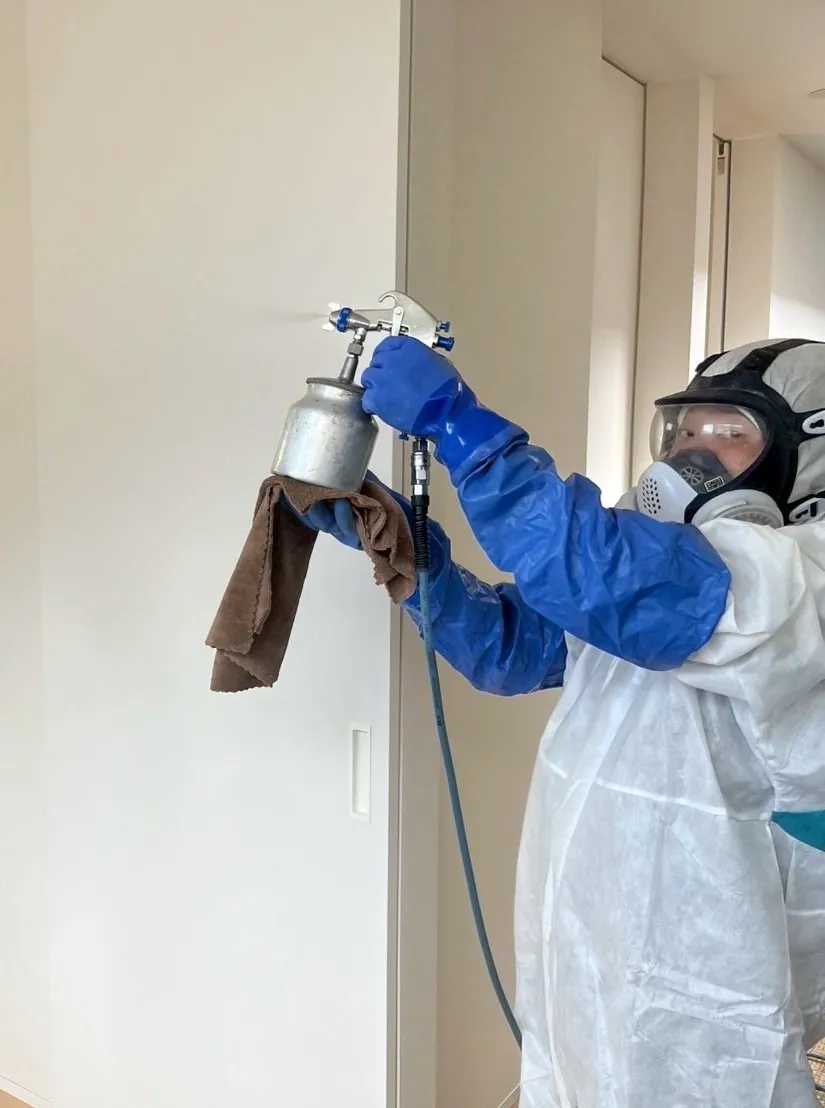
With this method, a specialized antifungal agent is sprayed in a fine mist that penetrates deep into materials, disrupting and inhibiting mold cell membranes at their core. Furthermore, an antimicrobial surface coating is applied, creating an environment that combines immediate effectiveness, long-lasting durability, and high safety. This ensures that the risk of mold regrowth is minimized, even after renovation.
For Mold Removal and Prevention, Trust Kabi Reform Nagoya & Tokyo and Kabibusters Osaka
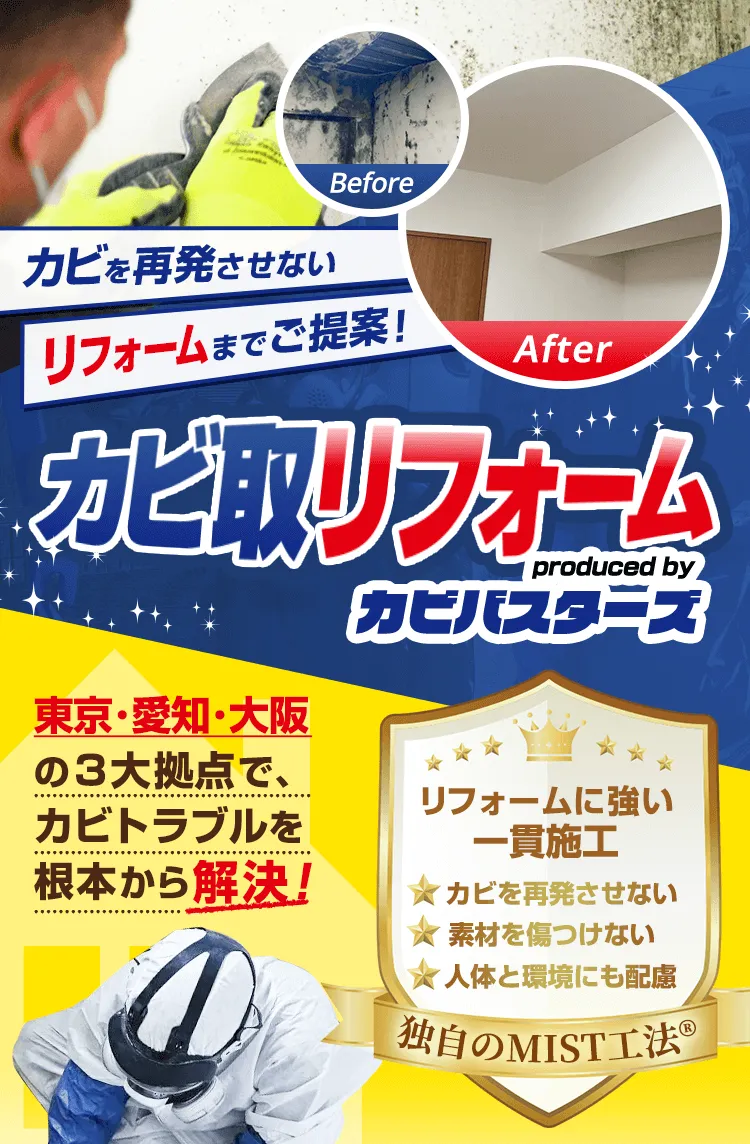
We at Kabi Reform Nagoya & Tokyo and Kabibusters Osaka are a specialized mold-removal team that has built a strong reputation and proven track record through community-based service. Our unique MIST Method® is a next-generation mold removal technology that decomposes and eliminates mold at its roots without damaging the material, and further prevents recurrence with advanced antifungal treatment.
The MIST Method® can be applied to a wide variety of materials, including wood, concrete, wallpaper, tatami mats, and stone. Without scraping or grinding, it eradicates deeply penetrated mold while preserving the original texture and value of the material.
After removal, a fine mist of antifungal agent is applied deep into the material, tackling airborne mold spores as well. This process provides immediate effectiveness, long-term durability, and high safety. Our extensive track record includes not only houses, but also stores, hospitals, senior care facilities, and even historic buildings, making it a reliable solution for projects where safety is a top priority.
Over the years, we have achieved success across diverse sites: completely eliminating black mold hidden inside residential walls, carrying out large-scale antifungal treatments in condominium bathrooms and common areas, and restoring historic buildings plagued by mold.
In particular, in the three major metropolitan areas of Osaka, Nagoya, and Tokyo, mold problems occur frequently due to highly airtight homes and structures prone to moisture retention. With bases in these regions, we are recognized for our ability to respond quickly on-site and provide flexible, tailored solutions for each project.
For construction companies seeking to propose mold removal that truly prevents recurrence, offer end-to-end solutions from removal to prevention, or partner with a trusted mold specialist, look no further than Kabi Reform Nagoya & Tokyo and Kabibusters Osaka. We deliver reliable expertise and proven technical capability you can count on.
---------------------------------------------------------------------
カビ取リフォーム
東京営業所
〒141-0022
東京都品川区東五反田2-5-2 YHE CASK GOTANDA6階
電話番号:090-8321-4408
名古屋本社
〒465-0028
愛知県名古屋市名東区猪高台1-1301 タイコウビル1F
電話番号 : 0120-588-766
サイト:https://taikou-kensou.co.jp/
大阪営業所
〒532-0003
大阪府大阪市淀川区宮原1-19-23
電話番号:080-6978-3068
カビバスターズ大阪
https://kabibusters-osaka.com/
【検査機関】
一般社団法人微生物対策協会
https://kabikensa.com/
----------------------------------------------------------------------